Published: 2026-05-23 07:33:26 UTC
Why Google Demand Gen's 5 New Surfaces Will Break Your Pipeline if you're not prepared. For dropshippers, e-commerce founders, and startups, the game has fundamentally changed. If you are still relying on traditional, slow creative production to feed the algorithm, you are getting locked out. Learn why you need to scale assets in minutes, not weeks.
Here is the math nobody in the agency world wants to talk about. A traditional creative production cycle for a single marketing video costs anywhere from $3,000 to over $15,000 and takes three to six weeks to deliver. That is just for one video.
Now, multiply that by the 15 to 20 distinct visual assets you need to properly feed a Google Demand Gen campaign across its newly expanded surfaces. You are looking at a five-figure invoice and an eight-week delay before you even run your first A/B test. And when the algorithm inevitably tells you that your expensive hero video is underperforming? You are forced back to square one.
This is not a budget problem. It is a production bottleneck. You are bleeding budget on production that does not convert because you cannot iterate fast enough. E-commerce founders and dropshippers are effectively locked out of competitive Demand Gen placements-not because the platform is too expensive, but because the traditional creative loop is too slow to match the pace the algorithm actually wants. If you cannot test multiple angles in real-time, you are losing money.
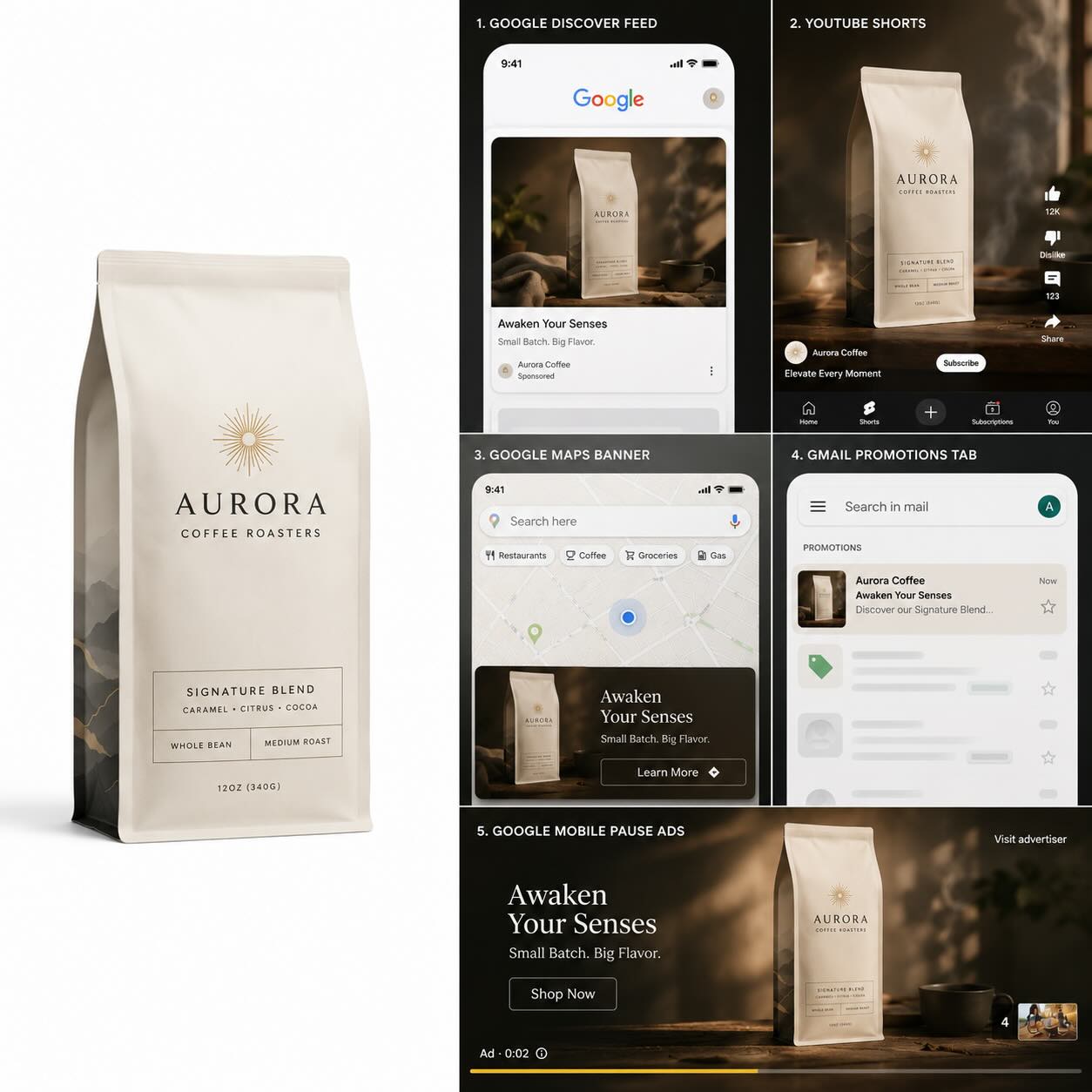
Google Marketing Live permanently changed the Demand Gen equation. The ecosystem just expanded beyond YouTube and Gmail to include Google Maps, Tablets, and Mobile Pause Ads. This introduces a fundamentally new type of intent signal. If a customer is navigating to a competitor's store on Google Maps, your ad can now intercept that exact moment. When they pause a YouTube video, your ad owns the entire screen.
But here is the trap: each new surface demands its own native AI ad creative.
Google confirmed on stage that product feeds drive 33% more conversions when populated with rich media. Even more critical, creator-style assets lift conversions by a documented 20%. That 20% is not a nice-to-have; it is the competitive gap between the startups that scale and the ones that burn out.
To win, you must feed the algorithm exactly what it wants across all five surfaces. Here are the Demand Gen asset specs you must hit:
The minimum baseline to test this matrix? Seven distinct assets. To actually optimize and scale? Fifteen to twenty assets minimum. The brands dominating Demand Gen right now aren't the ones with the deepest pockets. They are the ones with the fastest production pipelines. You either adapt your velocity, or you watch your competitors eat your market share.
This is where Truepix AI rewrites your production math. We do not sell a generic "tool." We sell Creative Liberation. Truepix AI is a Creative Orchestrator designed to move you from a Prompt Engineer tinkering with tech, to a Creative Director executing a vision. We use Intelligent Model Selection to automatically evaluate your prompt and route it to the optimal AI model—no expertise required, and no keeping up with the exhausting AI model hype cycle.
Here is how you produce an entire Demand Gen asset pack in minutes, not weeks:
Step 1: The Product Transform Taste Test
Bypass the expensive commercial photoshoot entirely with Product Transform. Start with a basic, boring product photo. Tell the AI your target surface and product benefits. Product Transform automatically generates physics-informed prompts and outputs professional, studio-quality commercial photography. You get clean hero shots for Google Maps, editorial lifestyle images for Discover, and high-energy 4:5 layouts for Gmail. This is the ultimate free-credit entry point to validate the aesthetic of your campaign.
Step 2: Autonomous Video with the ADS Agent
When you need to scale up to YouTube Shorts and Pause Ads, deploy the ADS Agent. Designed specifically for tangible products (it is not ideal for service or tech-based businesses), this Agent acts as your autonomous creative team. You input your product and audience; the Agent intelligently generates a concept, drafts the script, produces an AI voiceover, builds the visual prompts, and composites the final high-resolution video. Everything is copyright-free and ready to launch.
Step 3: Granular Control via The Supplementary File
AI generation usually feels like a slot machine—if you do not like the output, you have to spin again. Not here. Every ADS Agent output includes The Supplementary File. This is your safety net. It contains the exact text prompts used to create every single scene in your video. If one clip misses the mark, you do not scrap the whole ad. You take that specific prompt, jump into the Truepix platform, tweak one variable, and regenerate just that clip. Granular control without starting over.
Step 4: Scale Creator Content with Avatar
To capture that 20% conversion lift from UGC hooks without hiring influencers, use image to video or Avatar. Upload a single image of yourself or a stock persona, paste your script, and generate a hyper-realistic speaking video. It is the fastest way to A/B test creator-style hooks for YouTube Shorts natively.
Audit your top-spending Demand Gen campaign today. If you have fewer than 10 creative variants running across your image and video placements, your ROAS is actively being throttled by creative fatigue.
Take your best-selling product and upload its basic white-background photo into Truepix AI. Generate a 1:1 lifestyle image and a 4:5 contextual scene. Swap those two assets into your worst-performing Google Discover ad and watch the click-through rate respond to native, high-quality visuals.
The Google Demand Gen ecosystem has expanded beyond YouTube and Gmail to also include Google Discover, Google Maps, Tablets, and Mobile Pause Ads.
To test the matrix across all surfaces, you need a minimum of 7 distinct assets. However, to properly optimize and scale without creative fatigue, you need 15 to 20 distinct visual assets.
Traditional creative production takes three to six weeks and costs between $3,000 and $15,000 for a single video. The algorithm requires real-time testing across multiple native formats. Slow production cycles create a bottleneck that locks advertisers out of competitive placements.
Claim your free credits. Upload a boring product photo into Product Transform and watch what happens to it. Once you see what we do to a static image, you'll understand what the ADS Agent does to your entire ad budget. Scale your assets today and stop bleeding your pipeline dry.